
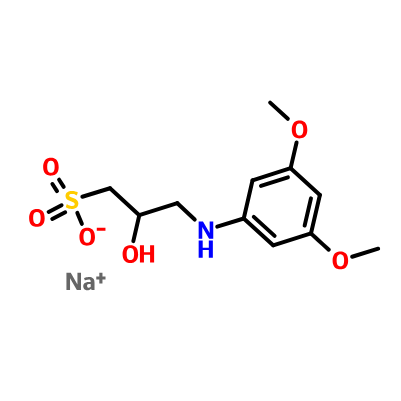

N-(2-Hydroxy-3-sulfopropyl)-3,5-dimethoxyaniline sodium salt CAS 82692-88-4
Category:
Product Description
Product Details
Introduction
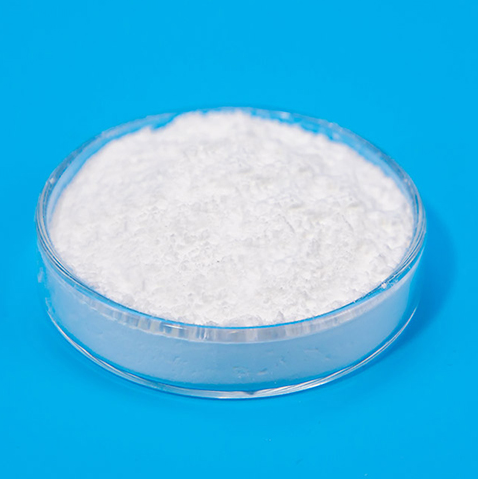
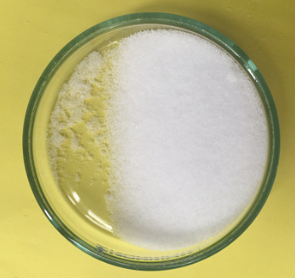
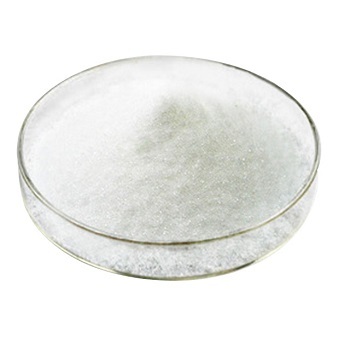
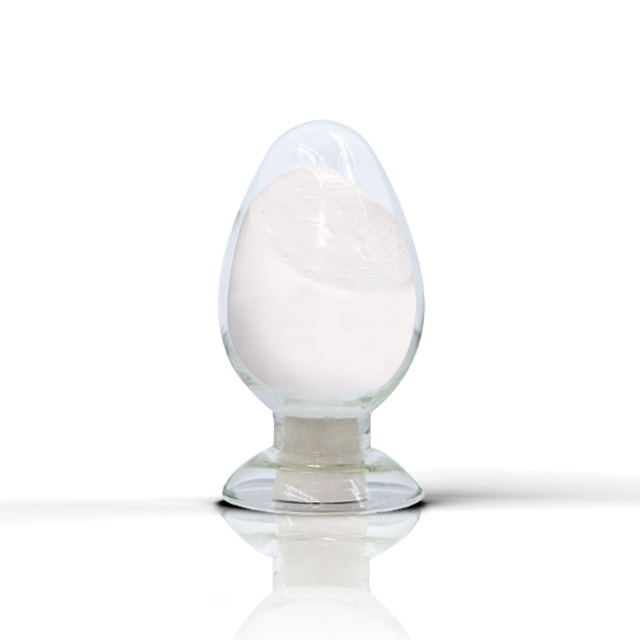
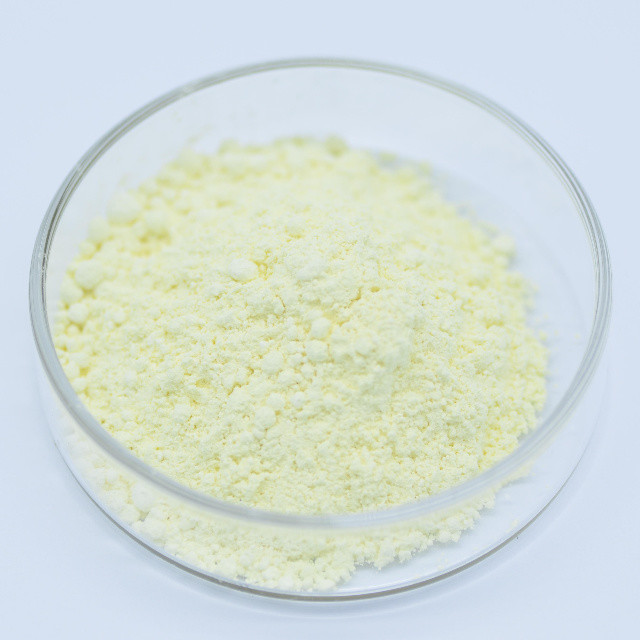
N-(2-Hydroxy-3-sulfopropyl)-3,5-dimethoxyaniline sodium salt, also known as HDAOS, is a white or off-white powder with a melting point of 144–149°C. It is highly water-soluble and is primarily used in colorimetric assays for hydrogen peroxide activity and in diagnostic testing.
Application
HDAOS is a high-purity product used for enzymatic photometric determination of hydrogen peroxide. It is an ideal reagent for diagnostic testing and biochemical tests. The purple or blue dye it forms is stable and has high absorbance, which can be used to determine the amount of substrate. The product has high purity and good water solubility, and needs to be stored away from light and moisture.
HDAOS can be used to detect enzyme activity, screen enzyme inhibitors, etc. In the field of environmental monitoring and food, HDAOS can be used to detect harmful substances such as heavy metal ions, pesticide residues, and food additives. In addition, HDAOS can also be applied to fields such as materials science and clinical diagnosis.
Advantages:
1. High sensitivity of colour reaction: HDAOS has high sensitivity of colour reaction. Researchers can judge the presence and concentration of substrate by observing colour changes so as to conduct quantitative or semi-quantitative analysis.
2. High selectivity: HDAOS can react with specific enzymes or other catalysts without interference from other molecules. This high selectivity has important applications in the biomedical field.
3. Easy to operate and analyse: Because it can perform characteristic analysis without complicated steps, it makes it easier to obtain and interpret experimental data.
Risk and Safety Statements
Hazard Codes | Xi |
Risk Statements | 36/37/38 |
Safety Statements | 26-36 |
WGK Germany | 3 |
You Also Like



Keyword:
N-(2-Hydroxy-3-sulfopropyl)-3,5-dimethoxyaniline sodium salt
HDAOS
CAS 82692-88-4
Send Inquiry
Leave a message immediately and receive free product consultation. We will arrange experts to contact you as soon as possible.